Three Regimes of Silicon Sampling: What Happens When AI Simulates the Canadian Electorate?
Canadian Political Science Association Conference (2026)
Abstract
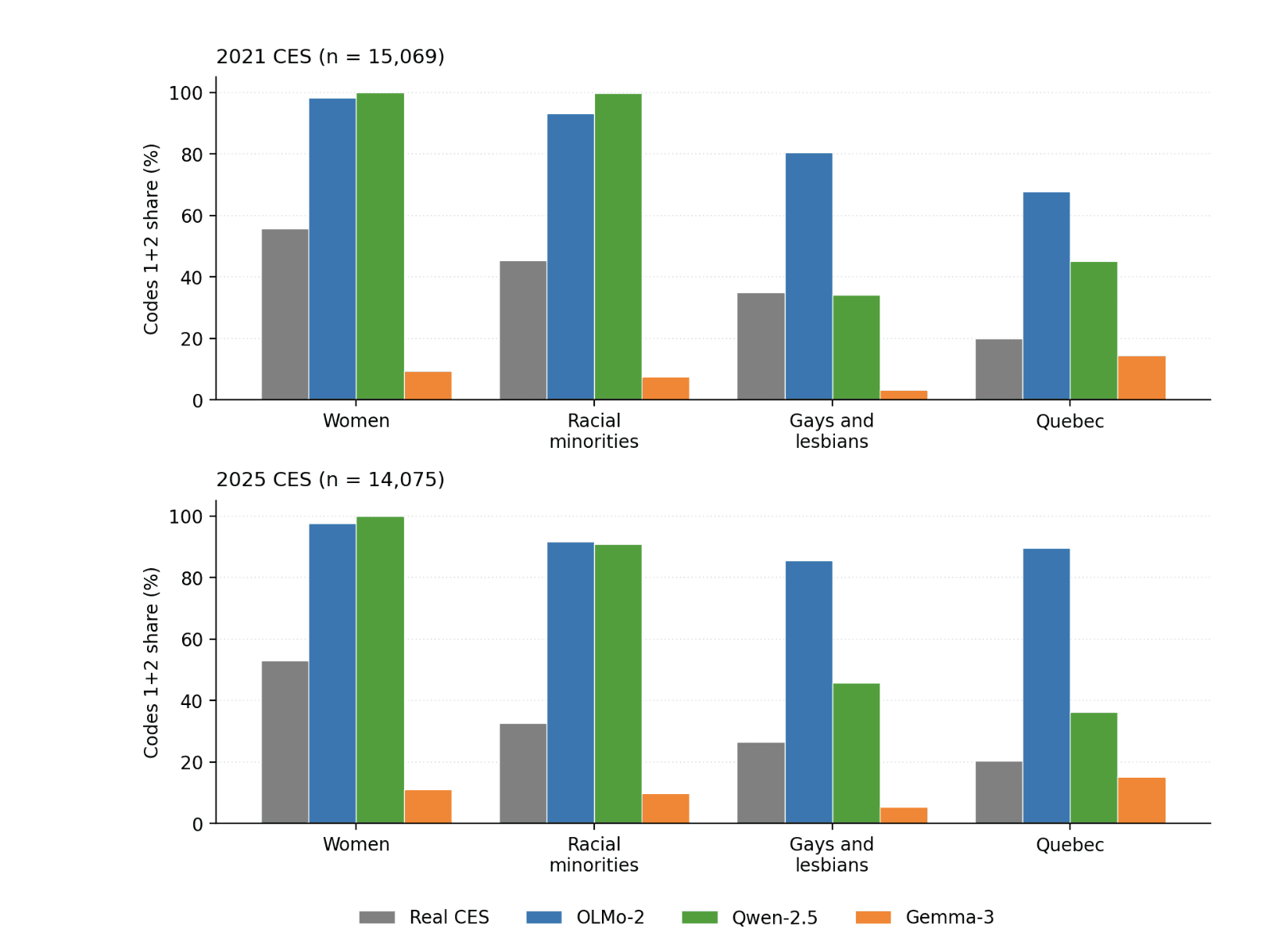
Falling response rates in survey research have prompted a recent proposal that AI language models can stand in for human respondents, a practice now referred to as silicon sampling. We administered the 2021 and 2025 Canadian Election Studies and the Maroto and Pettinicchio Canadian COVID-19 Response Survey of People with Disabilities and Health Conditions to three open-weight Al families. The disability instrument carried a stripped-vs-full persona-detail ablation; the CES held persona detail fixed across cycles. Richer persona prompts produce modest gains in accuracy, but the gain is beside the point.
Three failure modes recur across datasets and model families, regardless of how much detail the persona prompt carries: silicon sampling overconcentrates subgroup responses, compresses variance on attitude scales, and on questions touching identity-protected groups, predictive performance falls below what standard demographic statistics on the same features can already do. We argue against silicon sampling as a substitute for survey research, most pointedly on the populations whose voices are already hardest to recover.
Authors
Del Coburn, Mike Cowan, Christopher Greenaway
Copyright © 2026 – PATRON-ROTIP